The Berengaria overboard incident
Queen of HeartsOn the night of July 14, 1934, after a costume ball aboard the RMS Berengaria, Lady Georgiana Rannoch sees something large fall from the ship into the sea. Her alarm sets the crew searching, but neither the object’s identity nor anyone’s fate is confirmed. The incident turns an ambiguous glimpse into an urgent test of how a ship can respond when the sea may already have taken someone beyond reach.
The sighting in the darkness
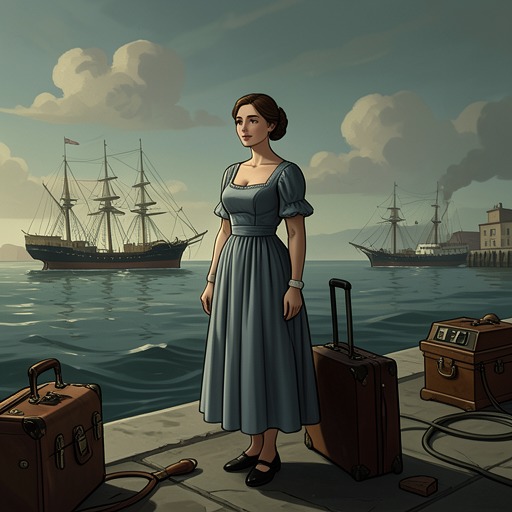
Georgiana has gone onto the deck after cocktails, with the ball’s slow waltz still audible behind her and an almost full moon shining on the black water. She is feeling melancholy and yearning when movement at the edge of her vision catches her attention: something large appears to fly out from the side of the ship and hurtle downward. A splash follows. The sound confirms that something has struck the water, but not what it was, or whether it was a person.
Leaning over the railing as far as she dares, Georgiana tries to make sense of what she can see in the moonlit bow wave. A shape seems to bob on the surface; she thinks she can make out a head and long, dark hair. Even that impression remains uncertain. When asked later to reconstruct the sighting, she describes seeing something come out of a window farther down the ship and fall into the sea. The account supplies a possible point of departure, not an identified passenger or a settled explanation.
From hesitation to alarm
For a moment, Georgiana does not act. The moonlight may be misleading her, and she fears looking foolish if she raises a false alarm. At the same time, she remembers a man pulling her back when she leaned over a railing at the dockside and considers whether someone, perhaps as drunk as Algie Broxley-Foggett, might have fallen. The possibility of a person in the water outweighs her hesitation. She runs inside and calls out that someone has gone overboard, correcting herself from man to woman and then to person as she tries to report what she saw without claiming more certainty than she has.
Passengers leaving the ballroom respond. Two men join her on deck while another goes for a crew member. A man opens a nearby teak chest, takes out life belts and throws them over the side as Georgiana indicates where she had been standing. The response begins with what is immediately available: people on deck, flotation equipment, and the witness’s uncertain location for the fall. The search is already constrained by what no one can establish—the object’s identity, its precise trajectory and whether anyone is actually in the sea.
The search against distance
The ship is travelling at twenty-six knots. Once the captain is informed, the engines are cut and the RMS Berengaria turns back. A searchlight from a lower deck sweeps the water, and a lifeboat is lowered, but the ship has been moving away from the splash at roughly a mile every couple of minutes. Georgiana and the others look into the darkness while the ship searches; the speed that made the distance accumulate also makes a successful recovery seem increasingly unlikely.
The scale of the ocean gives the scene its stark limit. A searchlight can expose a patch of water, and a lifeboat can be sent out, but neither can undo the time and distance between the fall and the alarm. Georgiana becomes sick and shivers as she watches. One of the men takes her inside and gives her brandy; the ballroom is now deserted, and her mother and her mother’s party are nowhere in sight. The change from music and dancing to an empty ballroom and a search at sea marks the abrupt passage from celebration to emergency without resolving what caused it.
An unresolved inquiry
On the bridge, the captain asks Georgiana to describe what she saw. She maintains that it was a person, while acknowledging that the dark hair and the fall are what she could make out. The captain orders a note of the cabins on the starboard side, but decides not to question their occupants immediately. If the search finds nobody and no passenger is reported missing by morning, the crew will take the next step; until then, he does not want to alarm passengers unnecessarily. The decision leaves the incident suspended between an emergency and an unverified sighting.
Georgiana is thanked for acting quickly and told that she will make an official statement in the morning. She is still frightened and sick, and on the bridge she becomes aware of the unnerving sensation that somebody is watching her, though she sees no one. That sensation deepens the scene’s unease but does not identify a watcher or explain the fall. The incident ends without confirmation that a person went overboard, without a recovered victim, and without an established cause. Its decisive consequence is the unanswered question it leaves aboard the ship: whether Georgiana witnessed a real person falling from a window, or saw an ambiguous shape that the darkness and distance made impossible to verify.